How COOs Cut Customer Support Costs and Make AI Actually Work

We help COOs and operations leaders reduce customer support costs, stabilize teams, and turn failed AI initiatives into practical, ROI-driven workflows their people actually use.

COOs reduce customer support costs by first identifying where costs are leaking, then prioritizing low-risk AI and automation initiatives based on ROI and operational constraints—before scaling anything across teams.

Choose the Lowest-Risk Path to Reduce Support Costs

Every engagement starts with cost visibility. From there, we help COOs sequence AI and automation in a way that delivers savings first—without disrupting teams or operations.

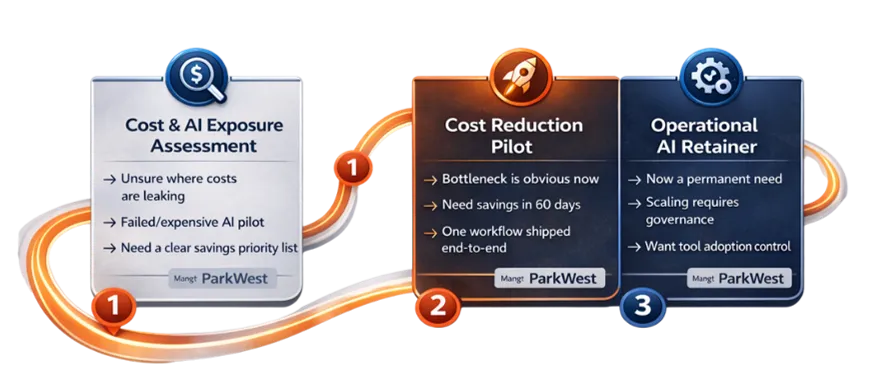
Cost & AI Exposure Assessment

Best for COOs who need clarity before spending another dollar

$5K Fixed

  • Identify where support costs are leaking

  • Surface AI initiatives that are wasting budget

  • Prioritize 2–3 savings opportunities before any build

Cost Reduction Pilot (8 Weeks)

Best for COOs who need measurable savings fast

$15K Fixed

  • Implement one high-impact workflow tied to cost reduction

  • Reduce contact volume or handle time within 60 days

  • Deliver before/after cost benchmarks

Operational AI Retainer

Best for COOs accountable for sustained margin improvement

$20K + Monthly

  • Ongoing cost optimization across support operations

  • AI governance to prevent tool sprawl and rework

  • Quarterly savings and efficiency reporting

How COOs Decide Where to Start

  • Start with Cost & AI Exposure Assessment if:

    → You’re unsure where costs are leaking

    →You’ve had a failed/expensive AI pilot

    →You need a clear savings priority list before building anything

  • Start with Cost Reduction Pilot (8 Weeks) if:

    → You already see the bottleneck

    → You need measurable savings in 60 days

    → You want one workflow shipped end-to-end

  • Start with Operational AI Retainer if:

    →Support cost is a permanent line item you must control

    →You need ongoing governance + reporting

    →You’re scaling and want to prevent tool sprawl

How We Build Your Business Roadmap

Outcome: a ranked roadmap and a first pilot plan designed to reduce support cost without disrupting operations.

Discovery & Cost Baseline

  • Confirm the cost drivers (contact volume, AHT, rework, churn triggers)

  • Lock the scoreboard: 3–5 KPIs we will move

Readiness & Constraints Scan

  • Assess systems, data, security constraints, and team capacity

  • Identify “fast-start” opportunities vs. dependency risks

Initiative Map + ROI Prioritization

  • Translate goals into 5–10 initiatives

  • Rank by ROI + effort + operational risk (what’s safest first)

Roadmap + Phasing Plan

  • Sequence into 30/60/90-day phases with dependencies

  • Define MVPs, pilot gates, and adoption plan

Pilot Execution + ROI Validation

  • Ship 1 workflow end-to-end

  • Measure lift vs baseline; iterate; lock the next wave

MEet your strategist

High-Stakes Customer Operations. Now I Help COOs Cut Support Costs With AI That Gets Used.

Hi, I'm Simmelle Zane

I help COOs and operations leaders reduce customer support costs and tool sprawl by turning failed AI efforts into practical workflows teams actually adopt.
I’ve led global customer operations and CX strategy at enterprise scale (including Apple and Adobe). Now I bring that playbook to mid-market teams who need measurable results—fast, without disruption.

If you’re under pressure to reduce support costs, stabilize performance, or prove ROI on AI—this is built for you.

Founder, ParkWest AI | Former Enterprise Customer Ops Leader | Certified AI Consultant

Frequently Asked Questions from COOs

How fast can a COO see cost savings from AI?

Most COOs start seeing measurable cost impact within 6–8 weeks when AI is applied to a specific, high-friction workflow.
The key is sequencing: we identify where costs are leaking first, then deploy one focused solution tied to contact volume, handle time, or rework — not a broad rollout.
Larger, sustained savings typically compound over the next 90–180 days as additional workflows are optimized.

Do you replace agents or reduce headcount?

No. Our work focuses on reducing waste, rework, and unnecessary contact volume — not replacing people.
In most engagements, teams become more stable because agents spend less time firefighting and more time resolving real customer issues.
Any headcount decisions remain fully in your control.

What if we’ve already failed with AI or automation?

That’s extremely common — and often why COOs reach out.
Most failures happen because tools were implemented before processes, data, or adoption risks were addressed.
We start by diagnosing what broke, why it broke, and what can realistically be salvaged before recommending anything new.

What systems and tools do you work with?

We work across most major customer support, CRM, and workflow platforms, including legacy systems.
Our role is platform-agnostic: we focus on how systems are used, where friction exists, and how automation fits operational reality.
If a tool isn’t appropriate, we’ll say so.

What do you need from our team to get started?

To begin, we typically need:

Access to high-level support KPIs

A current view of your support stack

One or two stakeholder working sessions

We design engagements to minimize internal disruption and fit alongside day-to-day operations.

How is this different from hiring a consulting firm or buying another AI tool?

We don’t sell software and we don’t lead with theory.
Our work is focused on cost visibility, operational sequencing, and adoption — so AI actually delivers ROI instead of creating more complexity.

Is this only for large enterprises?

No. Most of our work is with mid-market companies that feel enterprise-level complexity without enterprise resources.
That’s where focused cost reduction and smart sequencing matter most.

Ready to See Where Support Costs Are Leaking?

Get a Cost & AI Exposure Score—then we’ll map the fastest low-risk path to savings.

Office: Park City, UT

Call +1 435-214-1023

Copyright 2025 . All rights reserved